Demand Forecasting for Shopify Brands: The 51 Questions That Determine Accuracy
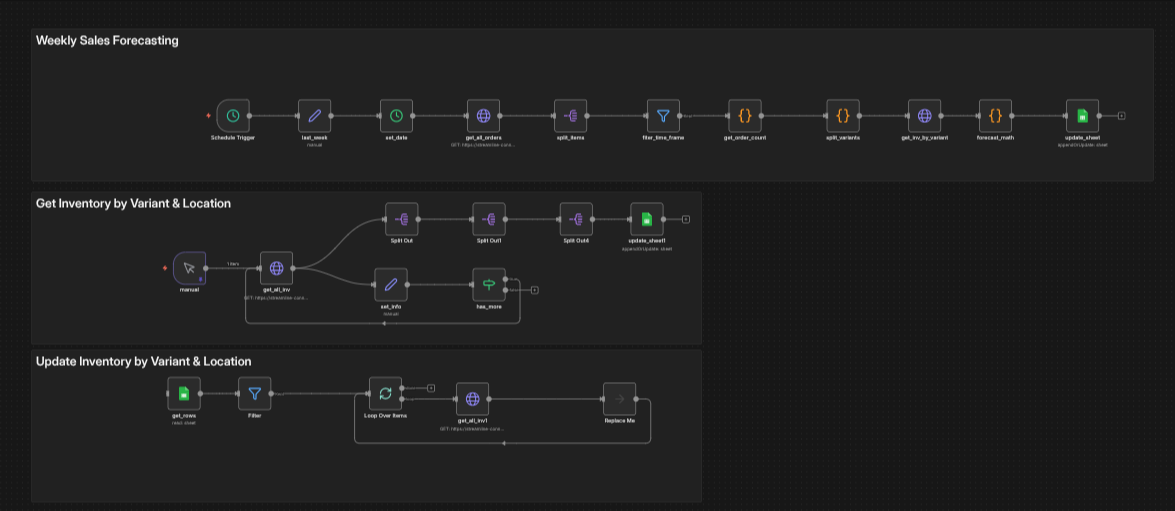
Most demand planning fails before math is ever applied. Not because teams lack tools, but because the inputs are flawed, incomplete, or misunderstood. These are the questions we require answers to before building any demand or inventory forecasting logic.
Section 1. Business Context and Goals
- What is the primary goal of inventory forecasting for your business?
- Avoid stockouts
- Reduce overstock
- Support growth and expansion
- Improve cash flow
- All of the above
- Which products are most critical to forecast accurately?
- Top revenue drivers
- High volume SKUs
- Long lead-time products
- Seasonal products
- Are all products treated equally, or do different product categories require different forecasting rules?
- Do you forecast at the product level, variant level, or both?
Section 2. Historical Data and Time Windows (Level 1)
- How far back should historical sales data be used for forecasting?
- 7 days: High volume, fast movers
- 14 days: Weekly patterns
- 30 days: Default for most SKUs
- 60 days: Slower movers
- 90 days: Low volume, long lead time
- Do different products require different historical windows?
- Should recent performance be weighted more heavily than older data?
- Do you want the ability to toggle or compare multiple time windows?
Section 3. Sales Spikes and Anomalies (Level 1)
- Do you experience abnormal sales spikes due to:
- Promotions
- Flash sales
- Product launches
- Influencer campaigns
- Holidays
- Should these high-demand days be:
- Fully included
- Partially weighted
- Fully excluded from calculations
- Do you want the ability to manually flag or exclude specific dates?
Section 4. Inventory Constraints and Ordering Rules (Level 1)
- Do your suppliers enforce minimum order quantities?
- Do suppliers ship inventory by:
- Unit
- Case
- Pallet
- Should forecasting logic respect pallet or case sizing rather than ideal unit demand?
- Are there cost or storage constraints that should cap order size?
Section 5. Vendors and Lead Times (Level 1)
- How many vendors do you work with?
- Do different vendors have different lead times?
- Are lead times:
- Fixed
- Variable
- Seasonal
- Do you want safety stock calculated based on lead time variability?
- Are vendor lead times currently documented and reliable?
Section 6. Data Sources and Data Integrity (Level 1)
- Where is your inventory and sales data currently stored?
- Shopify
- ERP
- Warehouse system
- Google Sheets
- Other
- What is the true source of truth for inventory levels?
- Is Shopify considered authoritative, or is it downstream from another system?
- Are there known data discrepancies between systems?
- How frequently is inventory data updated?
Section 7. Forecast Output and Interfaces (Level 1)
- Are you comfortable using Google Sheets as the primary forecasting interface?
- Do you require:
- Read-only dashboards
- Editable planning sheets
- Version history
- Do you want forecasts broken down by:
- Day
- Week
- Month
Section 8. Alerts, Notifications, and Actions (Level 2)
- Do you want alerts when inventory drops below forecasted thresholds?
- Preferred notification channels:
- Slack
- Microsoft Teams
- Should alerts be informational or actionable?
- Do you want automated purchase order recommendations?
- Do you want the system to automatically notify suppliers?
- Should supplier emails be:
- Drafted for approval
- Fully automated
Section 9. Returns and Adjustments (Level 2)
Phase 2 Consideration
- Do returns materially impact inventory accuracy for your business?
- Is returns data required for accurate forecasting from day one?
- Can returns logic be introduced in a later phase without breaking forecasting accuracy?
- What returns system do you use?
- Native Shopify
- Loop
- Other third-party system
- Should returned inventory immediately be treated as available stock?
- Are there delays between return initiation and restock availability?
Section 10. Future Expansion and Integrations (Level 2)
- Do you anticipate adding new sales channels in the next 6 to 12 months?
- Do you plan to integrate forecasting with:
- ERP systems
- Accounting tools
- Demand planning software
- Do you need multi-location or multi-warehouse forecasting?
- Do you expect forecasting logic to evolve as the business scales?
Final Validation
- Are there any operational constraints not covered above?
- Are there edge cases or past failures we should explicitly account for?
- What would make this forecasting system a clear success for your team?
If you want help translating these answers into a demand forecasting model that reflects how your business actually operates, you can get in touch.
- Validate demand signals
- Account for supplier and fulfillment constraints
- Build practical forecasting workflows that teams can trust and use
No dashboards for the sake of dashboards. Just forecasts that stand up in the real world.
Table of contents
Most demand planning fails before math is ever applied. Not because teams lack tools, but because the inputs are flawed, incomplete, or misunderstood. These are the questions we require answers to before building any demand or inventory forecasting logic.
Section 1. Business Context and Goals
- What is the primary goal of inventory forecasting for your business?
- Avoid stockouts
- Reduce overstock
- Support growth and expansion
- Improve cash flow
- All of the above
- Which products are most critical to forecast accurately?
- Top revenue drivers
- High volume SKUs
- Long lead-time products
- Seasonal products
- Are all products treated equally, or do different product categories require different forecasting rules?
- Do you forecast at the product level, variant level, or both?
Section 2. Historical Data and Time Windows (Level 1)
- How far back should historical sales data be used for forecasting?
- 7 days: High volume, fast movers
- 14 days: Weekly patterns
- 30 days: Default for most SKUs
- 60 days: Slower movers
- 90 days: Low volume, long lead time
- Do different products require different historical windows?
- Should recent performance be weighted more heavily than older data?
- Do you want the ability to toggle or compare multiple time windows?
Section 3. Sales Spikes and Anomalies (Level 1)
- Do you experience abnormal sales spikes due to:
- Promotions
- Flash sales
- Product launches
- Influencer campaigns
- Holidays
- Should these high-demand days be:
- Fully included
- Partially weighted
- Fully excluded from calculations
- Do you want the ability to manually flag or exclude specific dates?
Section 4. Inventory Constraints and Ordering Rules (Level 1)
- Do your suppliers enforce minimum order quantities?
- Do suppliers ship inventory by:
- Unit
- Case
- Pallet
- Should forecasting logic respect pallet or case sizing rather than ideal unit demand?
- Are there cost or storage constraints that should cap order size?
Section 5. Vendors and Lead Times (Level 1)
- How many vendors do you work with?
- Do different vendors have different lead times?
- Are lead times:
- Fixed
- Variable
- Seasonal
- Do you want safety stock calculated based on lead time variability?
- Are vendor lead times currently documented and reliable?
Section 6. Data Sources and Data Integrity (Level 1)
- Where is your inventory and sales data currently stored?
- Shopify
- ERP
- Warehouse system
- Google Sheets
- Other
- What is the true source of truth for inventory levels?
- Is Shopify considered authoritative, or is it downstream from another system?
- Are there known data discrepancies between systems?
- How frequently is inventory data updated?
Section 7. Forecast Output and Interfaces (Level 1)
- Are you comfortable using Google Sheets as the primary forecasting interface?
- Do you require:
- Read-only dashboards
- Editable planning sheets
- Version history
- Do you want forecasts broken down by:
- Day
- Week
- Month
Section 8. Alerts, Notifications, and Actions (Level 2)
- Do you want alerts when inventory drops below forecasted thresholds?
- Preferred notification channels:
- Slack
- Microsoft Teams
- Should alerts be informational or actionable?
- Do you want automated purchase order recommendations?
- Do you want the system to automatically notify suppliers?
- Should supplier emails be:
- Drafted for approval
- Fully automated
Section 9. Returns and Adjustments (Level 2)
Phase 2 Consideration
- Do returns materially impact inventory accuracy for your business?
- Is returns data required for accurate forecasting from day one?
- Can returns logic be introduced in a later phase without breaking forecasting accuracy?
- What returns system do you use?
- Native Shopify
- Loop
- Other third-party system
- Should returned inventory immediately be treated as available stock?
- Are there delays between return initiation and restock availability?
Section 10. Future Expansion and Integrations (Level 2)
- Do you anticipate adding new sales channels in the next 6 to 12 months?
- Do you plan to integrate forecasting with:
- ERP systems
- Accounting tools
- Demand planning software
- Do you need multi-location or multi-warehouse forecasting?
- Do you expect forecasting logic to evolve as the business scales?
Final Validation
- Are there any operational constraints not covered above?
- Are there edge cases or past failures we should explicitly account for?
- What would make this forecasting system a clear success for your team?
If you want help translating these answers into a demand forecasting model that reflects how your business actually operates, you can get in touch.
- Validate demand signals
- Account for supplier and fulfillment constraints
- Build practical forecasting workflows that teams can trust and use
No dashboards for the sake of dashboards. Just forecasts that stand up in the real world.